




Where To Use Thermal Grease in Automotive And Power Electronics?
Heat is one of the fastest ways to shorten the life of electronic components. In automotive modules and power Electronics, even a small air gap between a heat source and a heat sink can reduce cooling efficiency and push temperatures higher than designers expect. That is why thermal grease is widely used as a thermal interface material. Its job is to fill microscopic surface gaps and help heat move from the device into the heat sink or chassis more efficiently. Dow’s technical data for DOWSIL SC 102 describes it as a one-part, non-curing, non-flowing thermally conductive compound designed to transfer heat away from critical components, especially in computer, power supply, and automotive applications.
Our product is Dowsil SC 102, a thermally conductive grease for PCB, computer, power supply, and automotive thermal management. It is a white, one-part compound with 0.9 W/m·K thermal conductivity, 29,000 cP viscosity, 0.14% bleed, and 0.62 °C·cm²/W thermal resistance at 40 psi. Those figures matter because buyers usually do not choose thermal grease by name alone. They choose it based on whether it can stay in place, transfer heat reliably, and support cleaner, more stable assembly over time.
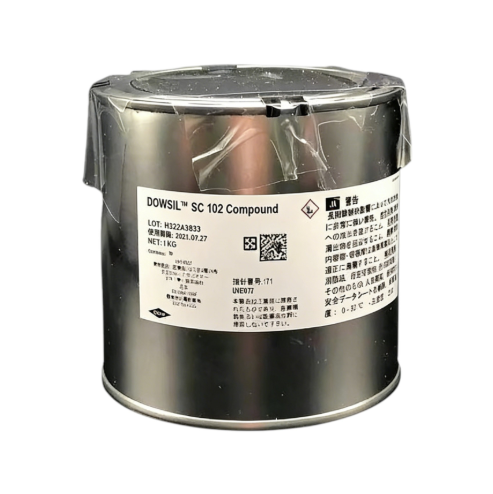
Table of Contents
- Why Thermal Grease Is Used In Electronics Assemblies
- Where To Use Thermal Grease In Power Electronics
- Where To Use Thermal Grease In Automotive Electronics
- Why PCB And Computer Cooling Are Also Common Use Areas
- What Buyers Usually Care About Before Choosing Thermal Grease
- How To Decide If Thermal Grease Is The Right Fit
- Conclusion
Why Thermal Grease Is Used In Electronics Assemblies
Thermal grease is not there to hold parts together. Its real purpose is to improve thermal contact between two mating surfaces that look smooth but are actually full of tiny surface irregularities. Infineon explains that thermal greases and pastes act as a bridge between mating surfaces, filling microscopic gaps and improving heat transfer from components such as power devices and other electronics. Dow’s data sheet makes the same point in practical terms, noting that these materials help maintain a positive heat-sink seal and improve heat transfer from electrical devices and PCB assemblies to the heat sink or chassis.
This matters even more in compact electronics. Dow notes that PCB assemblies are being designed for higher performance in smaller spaces, which means more heat is generated in less room and thermal management becomes a primary design concern. In power conversion circuits, Monolithic Power Systems also notes that heat directly affects efficiency, reliability, and lifespan. For B-end buyers, this is not just an engineering issue. It affects warranty risk, field failure rates, and long-term product stability.
Where To Use Thermal Grease In Power Electronics
In power electronics, thermal grease is commonly used anywhere a power device must transfer heat into a metal cooling structure. That includes interfaces between power semiconductors and heat sinks, power supply modules and chassis, and PCB-mounted hot spots and aluminum cooling surfaces. Our product is specifically listed for power supply device cooling, where it supports heat dissipation for adapters and industrial power units, and for PCB assembly thermal management, where it helps transfer heat between components and heat sinks.
This application direction makes sense because power electronics tend to generate concentrated heat. A power transistor, regulator, or converter module may be electrically small but thermally demanding. If that heat does not move out quickly, component performance can drift and reliability can drop. Dow’s data sheet also notes that thermally conductive compounds can achieve thin bond line thickness and relatively low thermal resistance, which helps move heat away from the device more effectively. That is one reason thermal grease remains a practical choice in power supplies, converters, and control boards instead of relying on bare metal contact alone.
Where To Use Thermal Grease In Automotive Electronics
Automotive electronics use thermal grease in places where electronic control and sensing functions generate heat inside a tight, vibration-prone environment. Our product is positioned for automotive electronics cooling, including vehicle control modules and sensors. Chemtronics also notes that thermal grease is used in automotive electronics such as engine control units and navigation systems to improve heat dissipation and prevent overheating.
In practice, the most relevant automotive use points are the interfaces between a heat-generating device and a metal surface that can spread or remove heat. That may include ECU housings, power control modules, LED driver boards, onboard power electronics, and sensor assemblies mounted in enclosed spaces. Automotive designs are often exposed to temperature swings, vibration, and long service cycles, so buyers usually care about more than thermal conductivity alone. They also look at bleed, stability, and whether the grease will stay where it is applied. Our product is non-flowing and low-bleed, which is useful in assemblies where movement, contamination control, and long-term positioning matter.
Why PCB And Computer Cooling Are Also Common Use Areas
The same thermal interface logic applies to computing and PCB assemblies. Our product is listed for computer and MPU cooling, including CPUs, motherboards, and computing modules. Dow’s technical sheet also names PCB system assembly modules used in computer, power supply, and automotive applications as its intended use. In all of these assemblies, the key requirement is the same: transfer heat from the device to a cooling structure more efficiently than dry contact alone can achieve. For buyers, this makes thermal grease especially useful in products that combine compact design with sustained heat generation. A small board with processors, power devices, or dense circuitry may not have much room for mechanical cooling improvement. In those cases, a grease with stable viscosity, high non-volatile content, and easy application can be a practical way to improve thermal contact without redesigning the entire assembly. Our product has 99.7% non-volatile content and supports application by screen printing, stencil, or spatula spreading, which helps in both batch production and rework.
What Buyers Usually Care About Before Choosing Thermal Grease
Most professional buyers do not ask only where to use thermal grease. They also want to know whether the grease fits their process. In production, the real concerns are usually consistency, rework, contamination control, and electrical behavior. Our product is a one-part, non-curing compound, so it does not require mixing or oven curing, and Dow highlights ease of application and rework as one of the advantages of thermal grease compared with many other thermal interface materials.
Electrical properties also matter in many electronics assemblies. Our product has 2 kV/mm dielectric strength and 2×10¹⁶ ohm·cm volume resistivity, which supports its use where thermal transfer is needed without creating an electrically conductive path. That combination is valuable in power electronics and automotive modules, where thermal performance must be improved without increasing electrical risk at the interface.
How To Decide If Thermal Grease Is The Right Fit
A useful way to judge fit is to ask three simple questions. First, is there a heat-generating component that must transfer heat into a heat sink, housing, or chassis? Second, are the mating surfaces imperfect enough that dry contact will leave air gaps? Third, does the assembly need a grease that is easy to apply, stable in place, and practical to rework? If the answer is yes, thermal grease is often worth considering. Infineon notes that thermal greases are widely used because of their good thermal conductivity and ease of application, while Dow points to their low cost and rework advantages.
For automotive and power electronics buyers, that decision is usually tied to the end product, not just the material. A reliable thermal interface can help a control module run cooler, a power supply last longer, or a PCB assembly stay more stable under continuous use. That is why thermal grease is usually selected as part of a broader thermal management plan rather than as a stand-alone material choice.
Conclusion
So, where to use thermal grease in automotive and power electronics? The most practical answer is at the thermal interface between a heat-generating component and the surface meant to carry that heat away. That includes power semiconductors, power supply modules, PCB hot spots, computer processors, vehicle control modules, and automotive sensors. Our product, Dowsil SC 102, is built for exactly these kinds of applications, with one-part handling, non-curing behavior, low bleed, moderate thermal conductivity, and thermal performance suited to PCB, computer, power supply, and automotive cooling work.
If you are comparing thermal interface options for automotive modules, PCB assemblies, or power electronics, feel free to contact us. We can help you review your application, operating conditions, and assembly needs so you can choose a more suitable thermal management solution.