



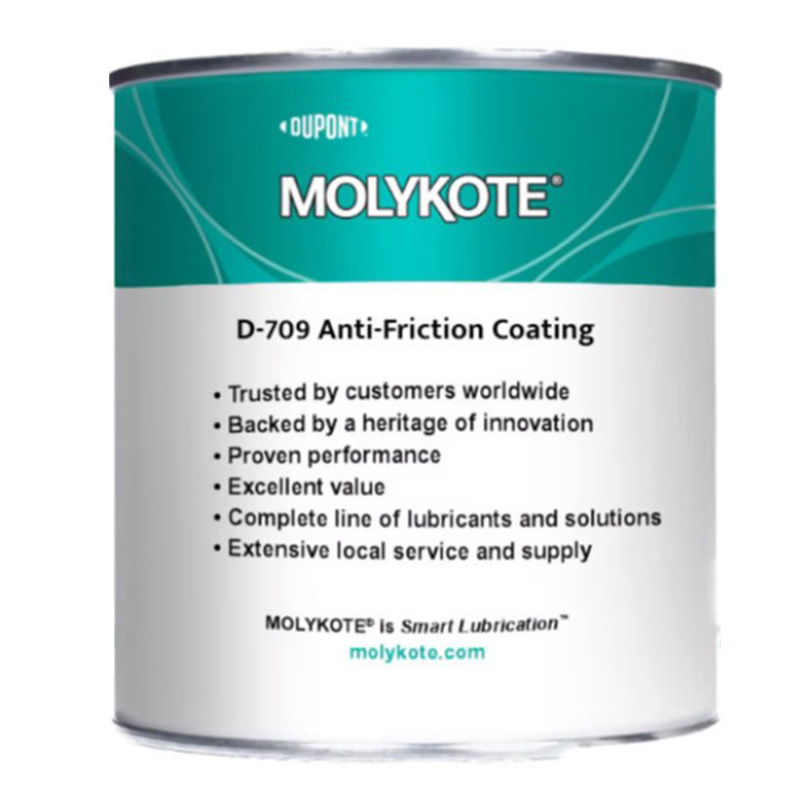
Molykote D-709 - Silver Anti-Friction Coating for Corrosion Protection on Metals
-
+852 9408 1652 WhatsApp
-
info@innosiltech.com Email
MOLYKOTE® D-709 Anti-Friction coating is a dispersion of solid lubricants (such as PTFE and aluminum) in an organic resin-solvent system that forms a silver-colored, dry film when heat-cured. It is applied by spraying or dipping, with a recommended film thickness of 5-15 microns, and cured at (180 °C) for 60 minutes. This coating provides durable, maintenance-free lubrication and operates effectively over a wide operating temperature range of -60°C to +240°C (-76°F to +464°F). Its clean, non-staining film is ideal for visible components and helps reduce noise and wear in various applications. This makes it suitable for visible components and precision assemblies where stable friction behavior, corrosion protection, and consistent performance are required without ongoing maintenance or re-lubrication.
products parameters
| Color: | Silver |
| Service Temp Range: | -60°C To 240°C |
| Cure Time @ 180°C: | 60 Min. |
| Salt Spray Test: | >300 H |
| Relative Density: | 0.96 G/cm³ |
| Packaging: | 1kg |
key features
Wide Temp Range - The cured dry film operates reliably across a service temperature range from −60 °C to 240 °C, maintaining friction stability during cold starts and prolonged thermal exposure. This range covers typical automotive interior and mechanical operating conditions, allowing consistent lubrication performance without softening or degradation when exposed to repeated temperature cycling.
Corrosion Protection - Salt spray testing demonstrates corrosion resistance of approximately 300 hours on properly prepared metal substrates. This level of protection reduces surface oxidation during storage and service, supporting component durability in humid or intermittently wet environments without the need for additional corrosion-inhibiting coatings.
Low Friction Film - The cured coating provides a stable low-friction interface for metal-metal and metal-plastic contact pairs, reducing sliding resistance and minimizing wear. This controlled friction behavior helps maintain consistent mechanical response over time, particularly in assemblies where torque repeatability and smooth motion are required.
Silver Appearance - After curing, the Molykote D-709 forms a uniform silver metallic finish that supports use on visible components. This controlled appearance allows easy inspection for coating coverage and consistency, supporting quality control processes in production environments where both performance and aesthetics are required.
Dry Lubrication - The dry film structure eliminates oil migration, evaporation, and contamination. This allows components to remain clean during operation, reducing dust accumulation and staining while maintaining lubrication performance over long service intervals without reapplication.
Film Thickness Control - Recommended application results in a cured film thickness typically within the 5 to 15 micron range. This controlled thickness supports precision assemblies by delivering lubrication without interfering with dimensional tolerances or mechanical clearances in compact components.
Automotive Door Systems - Applied by spraying or dipping to cleaned metal components before heat curing, Molykote D-709 is used on door latches and locking mechanisms to ensure smooth operation. After curing, the dry film supports quiet movement and corrosion protection without attracting dirt, making it suitable for long-term use inside door assemblies.
Safety Belt Mechanisms - Used on internal sliding and pivoting components of safety restraint systems, the coating is applied in a thin, controlled layer and cured to form a non-migrating lubricating surface. This method supports consistent belt movement while preventing contamination that could interfere with sensitive locking functions.
Brake Hardware Parts - Applied to springs, clips, and sliding guides in brake systems, the coating provides dry lubrication after curing. This approach supports smooth component movement during braking cycles while minimizing corrosion and avoiding lubricant fling that could contaminate braking surfaces.
Precision Mechanical Parts - Used on small components such as pins, washers, and springs, the coating is applied before assembly and heat cured to deliver stable lubrication. This method supports repeatable motion and reduced wear in devices requiring clean operation and consistent mechanical response.
Mixed Material Contacts - Applied to metal-plastic contact points, the coating reduces friction without damaging polymer surfaces. After curing, the dry film supports controlled movement under low to medium loads, making it suitable for assemblies where grease use is restricted or undesirable.