



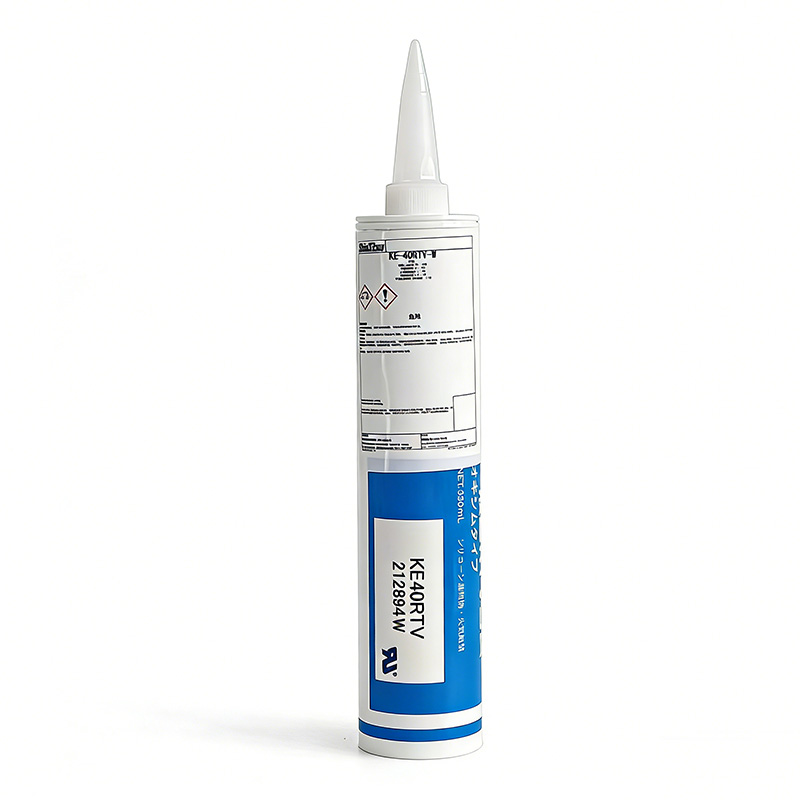
ShinEtsu KE-40RTV – Acetoxy Cure Silicone Sealant for General Industrial Sealing
-
+852 9408 1652 WhatsApp
-
info@innosiltech.com Email
KE-40RTV is a one-part acetoxy cure RTV silicone sealant designed for room-temperature sealing and bonding work. It is supplied as a ready-to-use paste with stable extrusion behavior, allowing users to apply it directly without mixing or preparation. During use, the material offers smooth tooling, consistent bead shape, and a predictable curing experience, making it suitable for routine sealing tasks where ease of handling and reliable curing response are important for daily installation or maintenance work.
products parameters
| Composition: | Acetoxy Cure Silicone |
| Appearance: | Paste |
| Viscosity: | ~85,000 mm²/s |
| Specific Gravity (25 °C): | ~1.12 |
| Refractive Index (25 °C): | ~1.410 |
| Packaging: | 330ml |
key features
Fast Cure - KE-40RTV cures rapidly at room temperature through an acetoxy condensation mechanism. Under standard conditions of 23 °C and 50 percent relative humidity, surface skin formation typically occurs within 5 to 10 minutes, while curing progresses at approximately 2 to 3 mm per 24 hours. This rapid response supports efficient installation schedules and reduced waiting time before handling.
Adhesion Strength - KE-40RTV develops strong adhesion to common substrates such as glass, ceramics, and metals. Typical tensile adhesion strength reaches 0.8 to 1.2 MPa under standard test conditions. This bonding capability supports stable joint integrity and helps maintain sealing performance under static mechanical loads.
Moisture Barrier - After full cure, KE-40RTV forms a dense silicone network that resists water penetration. Water absorption typically remains below 0.5 percent by weight after 24 hours of immersion. This barrier performance helps maintain sealing effectiveness and mechanical stability in humid or moisture-exposed environments.
Elastic Retention - The cured elastomer maintains flexibility over long service periods. Typical elongation at break exceeds 250 percent, while Shore A hardness generally falls between 20 and 30. These values support movement accommodation and vibration tolerance without cracking or loss of sealing continuity.
Material Stability - KE-40RTV demonstrates stable physical properties under normal service conditions. With a viscosity of approximately 85 000 mm²/s and a specific gravity around 1.03 at 25 °C, it provides controlled flow during application and consistent cured density. This stability supports repeatable application quality across different working environments.
Construction Sealing - KE-40RTV is used for sealing joints in building assemblies such as window frames and general construction gaps. Joint widths of 3 to 12 mm can be sealed effectively under normal ambient conditions. The cured sealant maintains joint integrity during temperature changes and routine structural movement.
Electronics Sealing - In electronics assemblies, KE-40RTV is applied to seal housings and components against moisture ingress. After curing, silicone layers typically exhibit volume resistivity above 1 × 10¹³ Ω·cm. This electrical stability supports moisture protection for non-heat-sensitive electronic enclosures.
Automotive Sealing - KE-40RTV is suitable for general automotive sealing tasks where flexible joints are required. The cured elastomer typically operates within a service temperature range of −40 °C to 180 °C. This range supports sealing performance under common automotive operating conditions.
Household Repair - KE-40RTV is widely used in household maintenance and DIY repair for sealing glass, ceramic, and metal surfaces. Its ready-to-use paste consistency allows controlled application without specialized tools. Predictable curing behavior supports reliable results for routine repair work.
Industrial Sealing - In general industrial environments, KE-40RTV is applied to seal panels, enclosures, and mechanical interfaces. Stable curing and adhesion performance support consistent sealing quality during assembly and maintenance operations. This reliability helps reduce rework and downtime in industrial settings.