



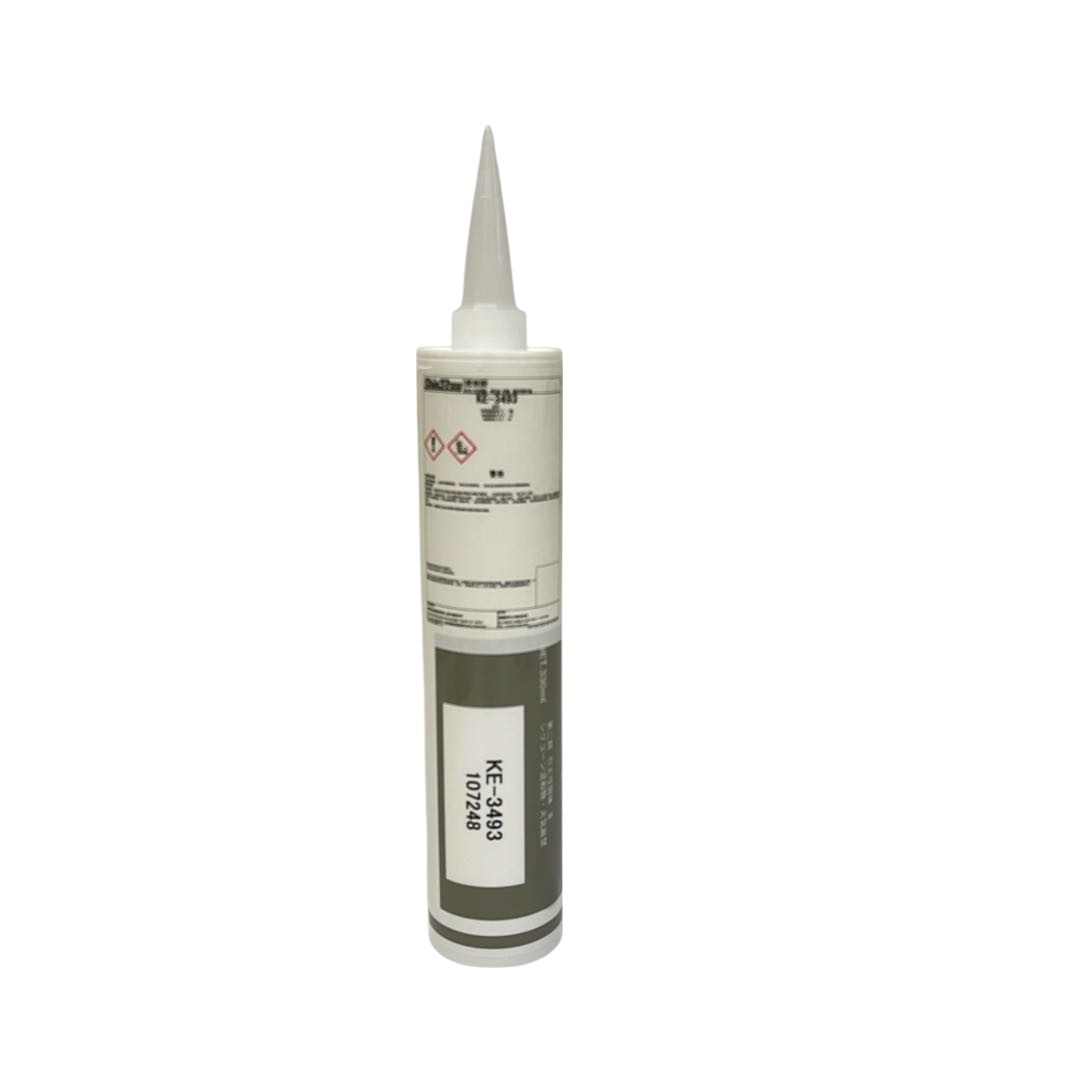
ShinEtsu KE‑3493 – High Strength Silicone Rubber for Industrial Molding & Sealing
-
+852 9408 1652 WhatsApp
-
info@innosiltech.com Email
KE-3493 High Strength silicone rubber is a two-component RTV silicone rubber designed to deliver a stable and controlled user experience during mixing, dispensing, and curing. In practical use, it presents as a viscous liquid system that blends smoothly and applies evenly, allowing users to achieve consistent results without sudden flow changes or handling difficulty. During curing, the material transitions into a tough yet flexible elastomer, providing a reliable tactile feel and dimensional stability.
Products parameters
| Composition: | Silicone Rubber |
| Appearance: | Viscous Liquid |
| Viscosity (25 °C): | ~13,000 mm²/s |
| Specific Gravity (25 °C): | ~1.13 |
| Refractive Index (25 °C): | ~1.410 |
| Packaging: | 330ml |
Key features
High Tensile Strength - KE-3493 cures into an elastomer with high tensile performance suitable for demanding mechanical environments. Typical high-strength RTV silicone rubbers demonstrate tensile strength levels exceeding 4.0 MPa after full cure, allowing the material to withstand sustained load and mechanical stress. This strength supports structural integrity where repeated deformation and load-bearing conditions are present.
Elastic Recovery - The cured silicone rubber retains excellent elasticity even after repeated mechanical cycling. Elongation at break for similar RTV silicone systems commonly exceeds 300 percent, ensuring that KE-3493 can stretch and recover without permanent deformation. This elastic behavior supports long-term dimensional stability during continuous movement or compression cycles.
Chemical Resistance - KE-3493 exhibits strong resistance to oils, solvents, and industrial fluids once cured. Chemical immersion data for comparable silicone rubbers shows minimal swelling and negligible loss of mechanical strength when exposed to hydrocarbons and common industrial chemicals. This resistance allows stable performance in chemically active environments.
Thermal Stability - The cured elastomer performs reliably under elevated temperatures, maintaining flexibility and mechanical strength over extended heat exposure. RTV silicone rubbers typically sustain continuous service temperatures above 150°C, with short-term tolerance at higher levels. This thermal stability ensures consistent material behavior without cracking or hardening.
Service Durability - KE-3493 supports long service life through stable mechanical and chemical properties. Long-term aging tests on similar high-strength silicone rubbers indicate low property degradation after extended exposure to heat, stress, and environmental factors. This durability reduces maintenance frequency and supports consistent performance over time.
Electronics Industry - KE-3493 is used in electronic assemblies where mechanical protection and material stability are required. Its cured elastomer provides cushioning and strain relief for components, supporting long-term reliability under vibration and thermal cycling commonly encountered in electronic devices.
Automotive Industry - In automotive environments, the material supports sealing and molding functions where resistance to heat, oils, and mechanical stress is necessary. The cured silicone rubber maintains elasticity under continuous temperature variation, contributing to reliable performance in vehicle-related systems.
Industrial Equipment - KE-3493 is applied in industrial equipment where durable elastomeric materials are required for sealing, potting, or vibration control. Its mechanical strength and chemical resistance support stable operation in equipment exposed to continuous load and harsh operating conditions.
Construction Industry - Within construction-related uses, the silicone rubber provides flexible and durable sealing performance. Its ability to accommodate movement and maintain adhesion under environmental stress supports structural reliability in building-related assemblies.
General Manufacturing - KE-3493 is utilized across general manufacturing processes requiring consistent molding and sealing materials. The predictable curing behavior and stable elastomeric properties support repeatable production outcomes and long-term component reliability.